Tuesday, September 21, 2010

The sounds of summer are dying

I know that summer is here when I start to hear the sound of cicadas, semi in Japanese. These little buggers are loud! If you are anywhere near trees or something they can hang out on, you are treated to the screeching of these annoying bugs. There are several different types of these guys who sound different and are active at different times of day. I forgot to mention how massive these guys are. It’s really no wonder they are so loud, I mean look at that thing!

This one is obviously dead

Did I mention that my island is vastly made up of forest? There is simply no escaping them. Until fall. Then they start to die and things get a bit quieter. A few weeks ago I started to see a few dead cicadas about and knew that the oppressive heat of summer would soon end and the cool breezes of autumn would find us at last.
It’s not bad enough that we have to hear them in person though. These guys are so closely associated with summer that our grocery store was playing a CD of their screaming to make people feel more in the summer mood. Also, any TV drama or movie or anime or video game that is set in the summer will clue you in to this fact with this sound in the background. So even once they’ve all died off I’ll still be hearing them.  And honestly, when it is quiet and this is all you hear it can get a little creepy...

Thursday, September 16, 2010

Teachers > Parents

So this morning when I got to school I saw one of my students in a car. That was rather strange as all of my junior high students ride their bikes or walk to school. Turns out that she twisted her ankle yesterday at volleyball practice. So this morning, her father drove her all the way to school to consult with the P.E. teacher as to if he should take her to a hospital or not. It was decided that she should go to the hospital to be checked out in case it was broken. Thankfully it is only a sprain, but she will still have to miss out on Sports Day this weekend which is a major bummer.

This whole scene was rather strange to me, because in America this would probably never happen. If a child was hurt at school and the parent went to pick them up they might ask the nurse’s opinion (or the sports couch’s opinion if hurt at practice) as to if they should go to the hospital. But I can’t really see someone driving the kid to school in the morning with the sole intent of asking if they should go to the hospital. Most parents I know would simply make that decision on their own.

This is really just another example of how much teachers are respected in Japan and how in many ways they are seen as the primary caretaker of the students. I’ve been told that if a student gets in trouble with the police the police will report to the school before they report to the parents. And like I’ve said before, many things that in America are the parent’s responsibility, fall on the teachers here such as good hygiene, morals and ethics, and citizenship. Of course this also leads to the phenomenon of Monster Parents, which will be discussed in detail at a later date.

This was just another reminder that I am in a different country with a different culture. Is it “wrong” to seek a teacher’s opinion instead of making the decision yourself? No, its simply different. Everyone had the student’s best interest at heart and she got what she needed.

By the way, this blog's 50th post is coming up.  There will be a very special post for that.  It's something I have had planned for a while and I promise it is amazing.  Look forward to it!

Monday, September 13, 2010

Picking up girls with elementary English

Okay….where to start with this one? First of all, I must put out a slight warning. The video that follows is inappropriate for younger children in at least one part. I’m not sure if anyone with younger children is even reading my blog (from the comments it seems to be mostly my college friends) but I figure I should put up the warning just in case. I really don’t mean to scandalize anyone. With that out of the way…

About a year and a half ago, Japan made elementary English lessons mandatory for fifth and sixth graders and introduced new textbooks for them called Eigo Noto. We have been mocking the CD that comes with these books ever since. Don’t get me wrong, there are a lot of things I actually like about Eigo Noto (although some will disagree with me), but the CD has some really weird intonations and accents at times. I like the idea of exposing the kids to different types of English and different accents, but this CD does less of that than exposing them to ridiculous sounding English.

Anyway, someone took the audio parts from the CDs, mixed them all around, and cut them together with visuals to make a video on how to pick up women. EVERYTHING that is said in this video (aside from the infomercial like opening and closing) is from the textbooks, although many are removed from context to allow for humorous reinterpretation. The video won first place at a Film Festival and is pretty well put together.  Again this is NOT what I am teaching my elementary school kids but an adult instruction video made from the same materials.  Enjoy.


I honestly don’t know how I’m going to get through some of these lessons now without bursting out laughing. And honestly, if there was a slightly edited version of this I would show it to my junior high boys and they might actually think English was worth studying!

Sunday, September 5, 2010

The Adventure of the Missing Bike

This all happened about two months ago and I’m honestly shocked I didn’t write an entry up about it before. But I was reminded of this incident the other day and feel it deserves to be shared.

I’ll start off by explaining that Japan is a very safe country. You can leave something somewhere and it won’t get stolen. There are only two exceptions to this, which I will get to in a moment. My friend even tried to get her laptop stolen (it was insured and she wanted a new one). She left it in the front seat of her car with the window open at least twice and yet it was always there when she returned. I’ve wandered over to get a soda, leaving my purse and backpack sitting out in the open and slightly out of my site. I leave my backpack with my computer outside on my bike when I stop to go grocery shopping. I do still always lock my apartment door, but we only sporadically lock the car doors. There just isn’t a lot to worry about.

One Tuesday I got off the ferry on Yokoura and was stunned to find that my bike was not there. I looked around thinking that someone might have moved it, but it was simply gone. So I had to walk around the island to school. It wasn’t so bad as I got to walk with some of my tiny elementary school students who were adorable and made me smile.

When I got to school I told my JTE that my bike was missing. At first he just thought I didn’t have my bike with me and it took a moment to make him understand that I had no idea where my bike was and that it was missing. Thus began the epic campaign of finding my bike.

He told the other teachers and I tried to give a description of my bike. I could only offer that it had a basket (like nearly all bikes in this country), a gray seat, and that my name was on the cover over the back wheel. I had last seen it the previous Thursday afternoon near the south port. They asked if it was locked. I told them it had a lock but I didn’t use it.

They assured me that it was probably still on the island somewhere and that someone had probably used it and forgotten to put it back. This is what I assumed had happened when I saw it was gone. Those two things I mentioned that do get stolen in Japan? Bikes and umbrellas. It’s less stolen than more or less seen as community property to some degree and people don’t feel bad using them.

Because this was interesting we used it in all of our classes that day. I told the kids the story with simple English and gestures for listening practice. They all understood, even my seventh graders who were still doing pretty basic stuff. We asked all the kids to keep an eye out for my bike, and they heartily agreed to help.

We had lunch in the hall that day (which is always my favorite since the whole school eats together instead of each grade eating in their own classroom). At lunch the principal again informed the students that my bike was missing, gave them the description, and asked for their help to find my bike. My JTE told me that the boys would run around the island that day after school for part of sports practice, so they could search the whole island as they went (there is one main road on this island and it makes a circle around the island). It really amused me that everyone was on a mission to find my bike. It made me feel good too because everyone wanted to help me. It was such a small thing and yet it was a big deal to my kids and my fellow teachers because they knew my bike was important to me.

In one of the last periods of the day one of the teachers needed to go to the post office, so she offered to take me with her to look for my bike. We took a truck that belongs to the school in case we found it, and drove the long way around the island so that we could check everywhere. We ducked down lots of alleys and went real slow. We were three fourths of the way around and I was losing hope when we came to the other port and low and behold, there was my bike. Then we went to the post office and returned triumphantly to the school.

That same teacher gave me a key chain for my bike key and now I do lock that bike when I leave the island (although I still don’t lock the other bike…). Since we found my bike at the end of the day I didn’t get a chance to tell my kids the good news. But two days later when I returned to the school at least 3 kids asked me if I had found my bike. They were really happy for me when I told them that it had returned and then ran off to tell all their friends the good news. It was so sweet that they remembered and cared. Those kids really mean a lot to me and its times like this that make me feel like I might mean a lot to them too.

Wednesday, September 1, 2010

It’s a sushi merry-go-round!

Today I shall explain the wonders of kaiten-zushi or conveyor belt sushi restaurants (often called, by me anyway, sushi-go-round restaurants). This type of sushi restaurant is very common in Japan. Upon arriving at the restaurant you are shown to a table. One side of the table faces a conveyor belt constantly in motion carrying various types of sushi and other small dishes around for the patrons. When you see something you want, you simply grab it off of the conveyor belt and eat. The plates are all color coded by price. At the end of your meal you summon the waiter with a push of the service button and they count up your plates and total your bill. Then you proceed to the front to pay.

There is a menu at each table, picturing everything that the restaurant serves (although some items may be covered up if they are currently out of season). If you don’t see something on the conveyor, or if you simply want to be sure that something is freshly made, you can call the waiter and order things specifically (sometimes they will tell you to check the conveyor as what you’ve asked for should be coming around). This is handy, especially if you are at the end of the conveyor belt on a busy night and the things you want seem to get scooped up before they get around to you. That being said, the best time to hit these places is when they are busy. It helps ensure that the food coming around is fresh and hasn’t been circulating for an unknown period of time. Tea is provided at each table, and water is often available from a pitcher somewhere in the restaurant. Soft drinks or alcohol must be ordered and come on plates of their own to be factored into the bill. Due to the nature of the restaurant a small wait staff can serve a rather large amount of customers.

This type of restaurant is great for groups, especially if you have people who eat drastically different amounts of food. Big eaters can take whatever they want and the small eaters can also get their fill without footing the bill for the big eaters. At the place we go to most plates are only ¥105, so it’s a good place to go if you are on a budget.

It’s a really fun experience, and it can encourage you to try strange things. Friends and I will often pick up something strange and each try one portion on the plate. If we like it we can grab more. If not, it’s not a big financial loss.

The most interesting sushi restaurant I’ve been to had a unique twist on this idea. It was a small restaurant so everything was made to order. When each dish was ready, the sushi was placed on a small boat like plate and set afloat on the small stream of water that circled the table. He called out what he was sending down the line to alert us to catch the little boats and retrieve our food. The same rules applied as the other restaurant; boats were color coded by price and at the end we called him over to tally up our bills. It was a really fun experience and the food was excellent.

Wednesday, August 25, 2010

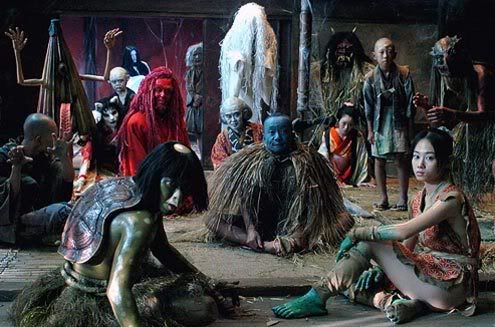
The Great Yokai War

I have always been fascinated by Japanese demons (yokai), ghosts, and legends. I often see yokai pop up in anime, manga, and video games and always find myself wanting to know more about them.

I recently got this game. It’s the newest Taiko Drum Master game for the DS and as you can tell from the cover it heavily features yokai. My love for these little guys was rekindled and I sought out to learn more about them and where I could find them.

In my bingeing of Wikipedia I found a movie called The Great Yokai War. And when we were at the movie rental store I casually mentioned to Eric that it was a movie I wanted to see. I couldn’t remember how the kanji in the title were pronounced or what they looked like, only what they meant. But that was enough and Eric found it with very little difficulty. It was actually easier for us to find this movie than most American movies in the store (mostly because we are never sure if the titles have been changed for the Japanese release).

With the help of the plot synopsis on Wikipedia we were able to piece together most of what was going on. The main character is a young boy named Tadashi who has just moved to a small town. At a festival he is named that year’s “Kirin Rider,” a protector of all things good. And wouldn’t you know it, a protector of all things good is desperately needed as a yokai named Kato is set on revenge against humans and is planning to attack Tokyo. But in order to do so he also betrays his own kind as he captures yokai and feeds them to a vengeful fire spirit to turn them into a mechanical army. A group of yokai seek out Tadashi in order to help him defeat Kato.

I fancied myself pretty familiar with Japanese demons and ghosts, but I was sorely mistaken as to the scope of what I was dealing with. Of the main group that helps Tadashi I only knew about the Kappa. The other three were completely new to me, and two of them don’t even have entries on Wikipedia. I knew a lot of the demons that made cameo appearances or had smaller roles along the way, but I was clearly reminded that I have a lot to learn. And that actually really made me excited to know more.

I found out that this movie was released in America by a company called Tokyo Shock back in 2006, so if this article has caught your interest you might be able to find it. I’m certainly going to look for it once I get back to the states. It isn’t the greatest movie you’ll ever see. The special effects are lame at points and the acting probably won’t blow you away. It’s a movie for kids, so it’s not especially deep or unpredictable. But the movie is fun, and if you want a glimpse into this side of Japanese culture it is definitely worth a look.

Thursday, August 19, 2010

Tan is bad

Whenever my female teachers head outside to do something with the kids, Sport’s Day Practice, Bike Safety Day, whatever, they prepare themselves. They all put on long sleeves, they put on hats with gigantic rims, and some even wear gloves. Now, I ask you, what season do you think this is during? Fall you say? Winter? Oh no, my friends. This is in the heat of the summer (although, I guess anything you said would be right, because if the sun is out they are bundled up, year round).

They are not fighting the chill. They are hiding from the sun. And they all do it. I have also noticed women driving with arm guards and gloves on to fight the sun while in their cars. At first I thought this was because of some hyper awareness of the dangers of skin cancer. But then I remembered that a large portion of this country smokes like chimneys, so that seemed less likely. And also, it is mostly just the women. I don’t see men going to nearly as many precautions to hide from the sun.

It turns out that here in Japan, no one wants to be tanned. This makes sense if you think back about the history of the country. When there were still nobles, most of them never went outside. They likely had rather fair skin. If you were very tan you clearly worked outside in a lower class job, like farming. And, as I believe is often the case, those who had money and power often set the view of what was considered beautiful and desirable in their women. Fair skinned women were prized. Look at the geisha and maiko who paint their faces white, bringing that pale beauty to an extreme. It gives a sort of untouched air to their beauty, untouched by the sun and untouched by blemish.

And so, this view has persisted at least in some degree. Women do not want to tan. They want to remain fair so as to remain attractive. I’m sure the damage that UV rays do cause is also a factor, but it also seems to be a convenient way to dress up this cultural view of beauty to make it even more necessary. Protect your skin and remain beautiful.

But there are also some people who still see it as a class thing as well. They don’t want to tan because they don’t want to be confused with someone who works outside all the time. They work inside and are thus a high class and want to maintain the appropriate appearance.

Part of the reason this never really transferred over to men is because your soldiers and warriors were outside too. If the samurai were out in battle they were going to tan as well, so for men it was just a standard thing. And perhaps that’s why my male teachers don’t seem to go to the same extreme when preparing for an outside activity. It reminds me of how women in America often diet, but you rarely hear of guys dieting, unless it’s for health reasons.

To further confuse you, I have seen women on the beach in bathing suits carrying parasols so that they can try to minimize their tanning. I rarely see people just lying out on the beach, working on their tan. And I have never, ever seen an artificial tanner or tanning beds advertised.