Showing posts with label Folklore fun. Show all posts

Thursday, June 16, 2011

Urashima Taro


So I’ve been reading a lot of old Japanese stories lately.  I’ve been studying Japan for so long that I guess I’ve grown used to many of these common stories that every Japanese child knows.  But I remember how thrilling and fun it was to hear them for the first time, and while many people reading my blog might already be familiar with them, some may not be and I’m happy to share them.  Since these are fairy tales many of them have multiple versions.  I’ll admit that I’m going to pick and choose my favorite details of the various versions and combine them into a story I hope you can enjoy. 

I’ll include the main story and then some comments about the story, such as cultural factors that may help explain certain things.  I’ll also include any pop culture references and comparisons to western stories.  And my random thoughts for your amusement.  These entries will likely be long, but hopefully they will be interesting and thought provoking.

Urashima Taro

Once upon a time there was a fisherman named Urashima Taro.  He was well known throughout his small fishing village for his kind heart.  One day he saw some young children tormenting a turtle on the beach.  Urashima offered the boys money for the turtle and released it back into the sea.  The next day the turtle came back to Urashima.  “I want to thank you for saving me,” he said.  “Please come with me to the Dragon King’s Palace.”  Urashima was very shocked at the invitation.  He had often heard of the spectacular palace deep beneath the sea, but in all his years as a fisherman he had never seen it or learned its location.  So he climbed on the turtle’s back and they began their journey.

 
Down they dove deep into the sea.  Urashima was surprised that he had no trouble breathing and his clothes never even got wet.  Sooner than he expected they arrived at the Palace.  It was far more beautiful than anything Urashima could have imagined.  All of the Sea Palace’s attendants, who of course were fish, welcomed him graciously.  Just then a beautiful woman appeared.  She was the Princess Otohime.  “Urashima Taro, yesterday you saved a turtle and I must thank you for that because that turtle was me.  Please stay with me here in the Sea Palace of the Dragon King and I will be your bride.  We will live forever together in happiness.” 

And so the Princess and Urashima Taro were married.  There was a celebration in the undersea kingdom as there had never been before.  Urashima was very happy and three days passed very quickly.  He seemed to forget about his life before as he was so blissfully happy with his new bride.  But then his mind came back to him and he began to worry.  He had left his elderly father and mother at home.  Surely they must be very worried about him.  He was a good and devoted son and resolved immediately to return to them. 

When he told Otohime of his wish to return she protested and cried.  “Are you not happy here Urashima?  You wish to return so soon?  Will you not stay just one day more with me?”  But Urashima had remembered his parents and the duty he owed them was stronger than ever his desire for pleasure and love.  “I do not wish to leave you, but I must go.  Let me return to them for one day only and then I will come back to you.”

Otohime saw that he would not be persuaded and agreed to send him back to his parents.  “Please take this token of our love with you,” she said and she presented him with a beautiful lacquer box tied with a red silk cord.  “What is this, my love?” Urashima asked.  “This is the Tamate-Bako (Box of the Jewel Hand).  It contains something very precious.  But you must not open it, no matter what happens.  You must promise me that you will never open the box.”  Urashima promised and said goodbye to Otohime.  Atop another turtle he returned to the beach near his home.

But things were strange when he arrived.  He recognized no one and the people stopped to stare at him.  The hills and the shore still seemed familiar but the people were all strange.  Quickly he returned to his home to check on his parents.  When he arrived his parents were nowhere to be found.  “Perhaps they have moved in my absence,” Urashima thought.  He found the new owner and said, “My name is Urashima Taro.  I lived in this house until a few days ago.  Can you tell me where my parents have gone?”  The man looked surprised.  “Urashima Taro?  It’s true there was a man who used to live here by that name, but that was three hundred years ago.  He couldn’t possibly be alive now.”  “But I am Urashima Taro!  This is my house.”  “That’s impossible,” the man replied.  “I’ve lived in this house my whole life,” and he went away.

Urashima looked around and began to fear that what the man said could be true.  Everything looked somehow different from when he had left.  What he had thought had been merely days had actually been hundreds of years and his parents and everyone he had ever known were gone.  He made his way back to the beach but he could not find the way to the Dragon Palace on his own.  He began to despair, but suddenly remembered the box that the Princess had given him.

“I have lost my home and my family.  I am alone and my heart is heavy with sadness.  The Princess said that this box contains a precious thing.  Surely if I open the box I will find something to help me find my way back to her.  There is nothing else for me to do now!”  And so he resolved to break his promise.  He slowly untied the red silk cord and carefully lifted the lid.  All that the box contained was a small cloud of purple smoke that washed over Urashima Taro.  Until that point Urashima had been a strong handsome youth, but he suddenly became very, very old.  His face filled with wrinkles, his hair turned snowy white, and he fell down dead on the beach, never to return to the Sea King’s Palace and his beautiful Princess.

-------------

The moral of the story seems to be to listen to warnings that other people give you and to keep your promises.  It does surprise me a little that his dedication to his parents isn’t rewarded at all.  That’s a big deal here in Japan and if he had just been a bad son he could have avoided the whole mess at the end. 

Apparently the Sea Palace doesn’t always make time skip around strangely.  The Palace appears in several stories I’ve read and in one they made it a point to mention that time didn’t pass any differently from the mortal world.  In all likelihood the story of the beautiful undersea palace came first and then different stories used the location in different ways.  But it is always difficult to find and incredibly beautiful.

The time Urashima spends in the Palace is sometimes different.  I think the first version had him spend one year at the Palace which turned into a hundred years back home.  But I like this version better as it doesn’t take him a year to think that maybe he might want to check in back home.  Also, in the first version I read I don’t think he marries the Princess.  I think they just partied for a year and then decides he should go home and check on mom. 

 
I have never liked the idea that the Princess doesn’t just tell him what has happened.  If he knew it had been 300 years then he wouldn’t want to leave anymore.  He would have just stayed with her and they could have stayed happy.  And the whole box test also strikes me as unfair.  I assume she knew what he would find back home.  This would clearly be rather upsetting and could lead people to make bad decisions.  He clearly wanted to go back to her.  He didn’t have anything else left for him.  It’s a little less cruel in the version where they aren’t married because she just tells him not to open the box and it isn’t a test of their love or anything.   In that case it was almost merciful because he had nothing left for him and the box aged him 100 years to the age he would have been if he hadn’t gone.  At least in that version it felt like it was somehow restoring the balance or something.  Here it’s just mean.

This story bares some similarity to the story of Rip van Winkle. 

This story is really well known in Japan and is referenced a lot.  I remember a Lupin the Third movie that had beautiful women who gave you a box that killed you. 


I think my favorite reference to this story is in the video game Okami.  Get used to seeing references to this game in this kind of article because it makes use of a lot of them.  In Okami you meet a young man who is trying to convince an old lady that he is her husband who was lost at sea years ago.  He was hurt and Otohime saved him and nursed him back to health.  But because he ate the food there he has eternal youth (or life, I can’t remember).  He returned to his wife as soon as he could but she doesn’t recognize him since he’s way too young to be her husband.  When you visit the Dragon Palace you meet Otohime and she gives you the box.  When you return to the surface you give Urashima Taro the box.  He opens it and ages to his proper age.  His wife recognizes him and they are able to spend the rest of their days together.  It’s really sweet and a nice twist on the otherwise downer ending.  


Wednesday, January 19, 2011

Common Japanese Fairytale Themes

I’m a really big fan of fairytales and legends and mythology from other cultures as I think it gives you an insight into the culture. I have been reading a bunch of Japanese fairy tales and I noticed some really common elements. I’ll share some of them with you here, along with the values they seem to reinforce.

1) Childless people

It has gotten to the point that if a story starts “There was once a man and his wife,” I can instantly tell that the next line will likely be something along the lines of, “They were very kind people but one thing troubled their hearts for they were childless and longed for a child to bring them joy in their old age.” In one book I must have read four or five stories that all started this way. Often the couple is older and has no child, but sometimes it’s a younger couple who work very hard to have a child. In one story the couple had a dog that they spoiled like a child. The virtue here seems to be that children are the greatest treasures of all.


2) Wicked Neighbors

It seems that beside every kind elderly couple lives a wicked elderly couple. Whenever the kind couple stumbles into some fortune or other the wicked couple grows jealous and tries to gain the same thing for themselves. This usually backfires, often due to their own greed, but instead of blaming themselves for their actions which led to trouble, they grow to hate their neighbors even more. This seems to be a pretty clear lesson of don’t covet your neighbor’s goods.


3) Horrid Stepmothers

Poor step-mothers. They really get a bad rap in fairytales the world over. Why is that exactly? The Japanese examples I’ve seen involve the step-mother being jealous of the attentions her new husband gives to his daughter. And the stepmother often tries to kill the girl, or at least tries to have her driven away by telling lies about her to her father. The stepmothers are always found out in the end and they either repent and learn to love the child or are driven away themselves. At first I would think that this was a lesson to be kind to your children, but the primary focus always seems to be on the daughter who endures the hardship patiently and remains dutiful to her stepmother despite her obvious malice. While I think both messages persist in these tales (especially when the stepmothers repent and learn to love their stepchildren) the big message always seems to be honor your parents no matter what.

This picture has nothing to do with stepmothers,
buuuuuuuuuuut I didn't have a picture for that one.


Wednesday, August 25, 2010

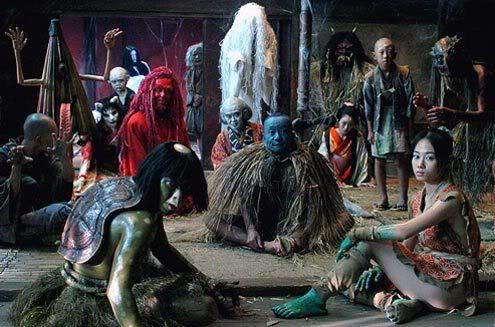
The Great Yokai War

I have always been fascinated by Japanese demons (yokai), ghosts, and legends. I often see yokai pop up in anime, manga, and video games and always find myself wanting to know more about them.

I recently got this game. It’s the newest Taiko Drum Master game for the DS and as you can tell from the cover it heavily features yokai. My love for these little guys was rekindled and I sought out to learn more about them and where I could find them.

In my bingeing of Wikipedia I found a movie called The Great Yokai War. And when we were at the movie rental store I casually mentioned to Eric that it was a movie I wanted to see. I couldn’t remember how the kanji in the title were pronounced or what they looked like, only what they meant. But that was enough and Eric found it with very little difficulty. It was actually easier for us to find this movie than most American movies in the store (mostly because we are never sure if the titles have been changed for the Japanese release).

With the help of the plot synopsis on Wikipedia we were able to piece together most of what was going on. The main character is a young boy named Tadashi who has just moved to a small town. At a festival he is named that year’s “Kirin Rider,” a protector of all things good. And wouldn’t you know it, a protector of all things good is desperately needed as a yokai named Kato is set on revenge against humans and is planning to attack Tokyo. But in order to do so he also betrays his own kind as he captures yokai and feeds them to a vengeful fire spirit to turn them into a mechanical army. A group of yokai seek out Tadashi in order to help him defeat Kato.

I fancied myself pretty familiar with Japanese demons and ghosts, but I was sorely mistaken as to the scope of what I was dealing with. Of the main group that helps Tadashi I only knew about the Kappa. The other three were completely new to me, and two of them don’t even have entries on Wikipedia. I knew a lot of the demons that made cameo appearances or had smaller roles along the way, but I was clearly reminded that I have a lot to learn. And that actually really made me excited to know more.

I found out that this movie was released in America by a company called Tokyo Shock back in 2006, so if this article has caught your interest you might be able to find it. I’m certainly going to look for it once I get back to the states. It isn’t the greatest movie you’ll ever see. The special effects are lame at points and the acting probably won’t blow you away. It’s a movie for kids, so it’s not especially deep or unpredictable. But the movie is fun, and if you want a glimpse into this side of Japanese culture it is definitely worth a look.

Sunday, August 15, 2010

Buddhist Proverbs: Part II

And we’re back for round two of Japanese proverbs inspired by Buddhist teachings. Part one is here if you missed it. Part two includes my top five favorites. Enjoy and leave me a comment below!

All things are merely dreams.
Thought the flame be put out, the wick remains.
Even Hell itself is a dwelling place.
Even the touching of sleeves in passing is caused by some relation in a former life.
Even a devil is pretty at eighteen.
A devil takes a goblin to wife.
Be the teacher of your heart; do not allow your heart to become your teacher.
Never let go of the reins of the wild colt of the heart.
Fish that escaped was never small; child that died was never bad.
With one hair of a woman you can tether even a great elephant.
Not to know is to be Buddha; not to see is Paradise.

Amanda’s Top Five!

5. The mouth is the front gate of all misfortune.

4. Nothing will grow if the seed be not sown.

3. Human life is like the dew of morning.

2. The fallen blossom never returns to the branch.

And my absolute favorite:
1. The interval of sleep is Paradise.


The shop boy by the temple gate repeats the sutra which he never studied.

I really like this one. It’s all about learning. In this case a young boy who works near a temple hears the priests chant the sutra every day and eventually he learns the words himself. It goes along well with another proverb, “Rather than study an art, keep in constant contact with it.”


Like a lot of blind men feeling a great elephant.

This one means to criticize without having a full idea of what you are talking about and refers to a fable in which a bunch of blind men try to describe what an elephant is by touching it. One guy feels only the leg and proclaims that an elephant is like a tree. Another feels only the truck and says that an elephant is a like a snake. One feels the elephant’s side and says that it is like a wall. Another only feels the tail and says that it’s like a rope. It’s easy to see that they are all very wrong and that by singling in on a small detail they have missed the big picture. Rather they have jumped to conclusions without taking the time to study further.


Even as the echo answers to the voice.
Even as the shadow follows the shape.

This one refers to the idea that however you act you will get the same type of thing back. If you yell harshly, your echo will return in harsh tones. But if you call out happily your echo will answer back happily. Kinda like what goes around comes around, reminding us to watch how we act. This is especially true for Buddhism where we have reincarnation as a factor. Every good thing done for us is a return of a good thing we did in a past life and every wrong inflicted on us is because we did wrong in a past life. It’s a giant balancing act and your life now (like an echo or a shadow) reflects what came before.


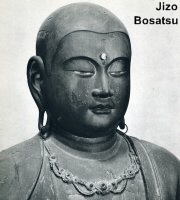
Borrowing time, the face of Jizo; repaying time, the face of Enma.

My book used pictures to describe this one and I’ll do the same.


Jizo

              
                  Enma

Monday, August 2, 2010

Buddhist Proverbs: Part I

A book I’m reading lists 100 Japanese proverbs to “illustrate certain effects of Buddhist teaching upon popular thought and speech.” Many of them are rather abstract and require gigantic footnotes to explain the translation for a foreign audience. But there were also a lot of them that I felt made sense without further explanation and I thought I’d share them with you. And there were a few that really need explaining, but I still really liked them, so I’ve done my best to explain. There ended up being quite a few, so I have divided them up into two posts for easier digesting. These are listed in no particular order.
Meeting is only the beginning of separation.
Hell and Heaven are in the hearts of men.
Heard of only, it is Paradise; seen, it is Hell
Good actions go not outside the gate; bad deeds travel a thousand ri.
The future life is the all-important thing.
Even a worm an inch long has a soul half an inch long.
The body is tortured only be the demons of the heart (or mind).
Even the Buddha was originally but a common man.
Even to become a Buddha one must first become a novice.
The blind man does not fear the snake.
There is no King on the Road of Death.
One confession effaces the sins of even three years.
Only by reason of having died does one enter into life.
All joy is the source of sorrow.
Joy and sorrow exist only in the mind.
Eggplants do not grow upon melon vines.


Even the head of an iwashi, by virtue of faith will have the power to save.

An iwashi is a small sardine like fish. It implies that what you worship matters rather little so long as your prayer is made with perfect faith and pure intentions. It’s all about the power of faith.


Having waxed, wanes.

Think of the moon. Once it has reached its fullest it begins to wane. So also the height of good fortune is also the beginning of fortune’s decline.


It is not easy to be born among men and to meet with the good fortune of hearing the doctrine of Buddhism.

Remember that we are dealing with reincarnation here. It takes many good lives to be blessed with being born as a member of mankind. And according to Buddhism, you are even more privileged if you are among those who are teaching Buddhism. This is because only as humans are we capable of spiritual progress. So no matter how miserable your situation, you should still be thankful that you are a person.


The Six Roads are right before your eyes.

Another to do with reincarnation. Our actions in our current life determine what we will be reincarnated as. So we are really in control of our own destiny and choose where we will be born next by acting appropriately in this life.


That will do it for part one! Please feel free to discuss in the comments, I’m really interested in what people think. Let me know if there is one you find particularly interesting, or if there is one that you don’t understand. I don’t know how familiar everyone is with Buddhism, and so some that I think make sense might make no sense to everyone else. If this happens I’ll do my best to try to explain. Check back later for part two which includes most of my favorites.

Thursday, July 22, 2010

Daruma dolls

I mentioned Daruma dolls briefly in my last post. I was about to include more details on the little guys when I realized that I could probably just write a whole post about them. These little guys are really common in Japanese culture so you may have seen them before but not really known what they were.


 Daruma dolls are usually red and have the face of a bearded man. However, a great variety of designs does exist. They are apparently modeled after Bodhidharma, the founder of Zen Buddhism. Bodhidharma really existed and he is mentioned in many historical records. But no biographical records really exist and the man has become more of a legend. He is usually seen as a very devote but somewhat senile monk. He is apparently well known for his practice of “wall-gazing” or staring at a wall in meditation for long periods of time. One legend claims that he sat facing a wall while meditating for nine years without moving, which caused his legs to fall off due to atrophy. Another legend says that he fell asleep during this nine year meditation. He was so angry at himself that he cut off his eye lids to prevent himself from falling asleep ever again, and his discarded eyelids sprouted the first tea plants. All in all he seems like a rather hardcore monk.


Daruma dolls are typically red because high ranking priests in Zen Buddhism wear red. And since Bodhidharuma was the founder of the sect, he surely must have worn a red robe. They are usually made of papier-mâché and are weighted at the bottom so that they always return to an upright position when tilted over. In Japanese this type of toy is called “okiagari” for get up (oki) and arise (agari). Because of this, Daruma dolls are symbols of perseverance, the ability to have success, overcome adversity, and recover from misfortune. They are often seen with the phrase “Nanakorobi Yaoki” which mean fall down seven times, get up eight times.

Apparently the facial hair on the dolls is also significant. The eyebrows are commonly shaped to resemble a crane and the cheek hair to resemble a tortoise shell. The crane and the tortoise are symbols of long life as the crane is said to live 1,000 years and the tortoise 10,000 years. I can see the crane in the eyebrows of some of the dolls, but I have trouble seeing a tortoise shell in the cheek hair. And many of the dolls don’t seem to carry these symbolic markings.


The last really common feature is that they are normally sold with blank eyes. This can look a little creepy, but it has a really interesting explanation. When you are going to start a big project or set a goal you fill in one of the eyes. Then, every time you see your one eyed Daruma doll you are reminded of your goal and work toward it. Even if you have trouble you remember that the Daruma always gets back up and you keep trying. When you accomplish your goal you fill in the other eye. The promise of getting full eyesight is also supposed to encourage the Daruma to help grant your wish. So they are good luck to have around when you are working on something big. In the video game Okami there were several one eyed Darumas in the game. If you filled in the other eye with your Celestial Brush you got a reward.

Daruma dolls are “effective” for one year. At the end of the year it is customary to take the Daruma doll back to the temple you bought it from. Just after New Year’s Day the temples hold a traditional burning ceremony. Here you can express your gratitude to the dolls for their help and purchase new dolls for the next year.

A random side note I thought was interesting: In the Edo period merchants were considered low class and so they developed their own cultural humor making fun of things that the higher classes held sacred. And so the Daruma was satirically depicted as a prostitute since they both share resilience for laying down and getting right back up. Female Daruma are still seen today, although now they have the same wholesome image as their male counterparts.


In Japan a snowman is known as a yukidaruma. Yuki means snow. Japanese snowmen almost always have two parts as opposed to the western standard of three. Baskin Robins (often simply called 31 here) is having a summer promotion of two scoop yukidaruma ice-cream, a large bottom scoop and a smaller second scoop.


One last thing I should probably have included in the last entry is Daruma Otoshi. This ancient game has a Daruma doll in 6 pieces. The game is played by using a small hammer to try to knock out each piece from bottom to top without knocking the whole things over. The game is still common today and I’ve seen my elementary kids play it.


While most places I looked at agreed that different colors had different meanings, they didn’t seem to agree on what the different colors meant. On one site a blue Daruma was for health and longevity and on another it was for personal achievement and success. White was listed as love and harmony, new birth and best wishes, or purity of mind and a wedding present. Purple was long life and preventing disasters or advancement in career. Green could be to remind you of your beginners mind at all times (?) or be for good health and vitality. Other colors are a bit more standard. Red is always general good luck and gold seems to always be associated with wealth. Several sites agree that yellow is for security and protection. Black seems to be for warding off evil and for a successful business year. Only one site listed orange and it was listed as success in school. Pink almost always seems to be associated with love and relationships and childbirth. Basically my best advice is to check with the temple or place you buy one from and see what they recommend. Internet options also exist such as this one which is in English and has some really good info.

Saturday, July 10, 2010

Komainu

Here is some more info on the komainu. I thought they were pretty interesting and deserved further detailing.

While researching for this entry I began to get a little confused. There were two terms for these things, komainu and shishi, floating around and I couldn’t figure out what the difference between the two was. I am still not 100% clear on the answer. The name shishi seems to come from Chinese (shi meaning both stone and lion). It seems that when they are referred to in a mythology sense they are usually called shishi. At first I believed that those in front of Shinto shrines were always referred to as komainu. But it seems that one should be called a shishi and the other a komainu. However, even in Japan, most people use komainu to refer to both of them. It really seems as though the terms are more or less interchangeable these days and that while a difference between the terms surely existed, it is starting to be lost, or at least isn’t agreed upon. Shishi and komainu were once two separate Wikipedia pages, but now they have been very awkwardly combined further supporting my theory. And my final weird note is that if I search Google in Japanese I get lots of picture of these things with the term komainu, but almost none with shishi. In this entry I’m going to operate on the assumption that they mean more or less the same thing and go from there. Now that that’s out of the way…


At Shinto shrines in Japan, two of these lions stand guard against evil. One is portrayed with his mouth open, the other closed. My Japanese English teacher was the one who told me that it isn’t a dog, even though it has dog in its name, although on Wikipedia it calls them dogs and just says they look like lions (so remember, don’t trust Wikipedia!). These stone lions were imported from China, like lots of other stuff that ended up in Japan. Legend portrays the shishi as playful but protective in nature. Although they are said to be very protective of their cubs they are also said to throw them off of cliffs to test their strength. Talk about tough love…

Interestingly though, in China these lions were used mostly for Buddhist temples and the Imperial Palace, while the komainu are a Shinto thing. Even more interesting is that there is no evidence of lions EVER being indigenous to China. However, Asiatic lions were common in India, and as Buddhist priests from India came to China, so did stories of these stone guardian lions that stood in front of and protected temples, monasteries and palaces in India. Now, no one in China had ever seen a real lion before, but they wanted these fearsome stone guardians to protect their temples too. So they modeled their versions after native dogs (dogs are fearsome too after all), such as the Chow Chow (whose name apparently literally translates to “puffy lion dog”).


Since the things were modeled after dogs in the first place and no one in Japan had probably ever seen a lion either (after all, the Japanese word for lion is raion in katakana, ライオン , indicating that it came from western influence much much later than these things came to the country), it makes sense that the Shinto version of these guys are named as dogs, as that is what they most closely resemble. Japanese people might have seen a Chow Chow after all.

These things always occur in pairs. The male is always on the left and the female on the right (from their prospective, so facing them it is the opposite). The Chinese (Buddhist?) versions play with a ball (male) and a cub (female), while the Shinto versions seem to be lacking this distinction (a set on my island features both with a ball, for example). The ball represents the Flower of Life while the cub represents the life cycle. The male lion protects the structure itself while the female protects those inside the dwelling. Then there is the distinction of the male having an open mouth and the female a closed mouth. The significance of this is unclear though. In some cases it is said to represent the sounds of the sacred word “Om” (open mouth= A; closed mouth =M), the supposed first and last sounds of the universe. Other cases claim that the male in inhaling (mouth open) representing life and the female is exhaling (mouth closed) representing death. And there are probably even more ways to interpret these things.


But as with many Japanese things, I’m sure a lot of you have seen these things before and just didn’t realize it. Anyone remember the Mighty Morphin Power Rangers? In the second season, the Black Lion Thunderzord is a shishi.


And remember Pokémon? Growlithe and its evolution Arcanine are based on the shishi, as is the legendary Pokémon Entei. Now it kinda makes sense why most of the Officer Jenny characters had a Growlithe. It is a protector after all.


One also appears in Final Fantasy X as a sidekick to Yojimbo.


And if you’ve seen the movie Kill Bill you may remember that the image of a shishi can be seen on the lower half of the blade of The Bride’s sword.


And remember Ojarumaru? Of course you don’t. But I watch it almost every day. It’s been running since 1998 and apparently has over 1000 episodes! It has characters that are komainu and come to life for various misadventures.


If you like this kind of entry let me know. I recently bought two books all about various Japanese demons that I’d love to have an excuse to try and translate. I have TONs of info on Japanese mythology and folklore and would love to share it if people are interested. But I only know what you tell me in the comments below!

Wednesday, July 7, 2010

Tanabata - The Star Festival

So today is a holiday here in Japan that most people probably don’t know about, so I figured I’d give a little run down. July 7th is Tanabata, also called the Star Festival. One of my kids wrote a poem about it in the previous post, and now you’ll finally know what he was talking about!

The story goes like this:

A long time ago the Tentei (or Sky King, but think less like God and more like the entire universe itself) had a beautiful daughter named Orihime (whose name literally means Weaving Princess). Orihime would sit by the banks of the Milky Way (Which in Japanese is 天の川, amanogawa literally “river of heaven”) and weave beautiful cloth. She worked hard every day. But she was very sad because, since she worked so hard, she would never be able to meet a boy and fall in love. Tentei wanted his daughter to be happy, so he arranged for her to meet Hikoboshi (lit. Cow Herder Star), a cow herder. When they met they fell instantly in love and were soon married. This should have been a very happy time, but they were so busy with each other that Orihime no longer wove cloth and Hikoboshi let his cows roam all over the heavens. Tentei was very angry and separated the two lovers, sending Hikoboshi to the other side of the Milky Way and forbidding them to ever see each other again.


Of course, they were both very sad. Orihime begged her father to let them met again, and Tentei agreed that if Orihime worked hard and finished all of her weaving that the two could meet once a year on the 7th day of the 7th month. Orihime worked very hard and when the day arrived she had finished all of her work and it was as beautiful as ever. When the two went to meet however, they found that there was no bridge and they could not cross the river. Orihime cried and cried. A flock of magpies heard her crying and came to the pair. They made a bridge out of their wings so that Orihime could cross to Hikoboshi. It is said that if it rains on Tanabata that the magpies cannot come and the couple must wait another year to meet (hence, most people wish for good weather on this day).


You can still see the pair in the sky. Orihime is the star Vega and Hikoboshi is the star Altair.

So how do we celebrate the reunion of these two hard working lovers? Most people write wishes on thin paper strips and hang them from bamboo along with many other paper decorations. These wishes were traditionally for things like better handwriting and improved skill at weaving or other crafts, but today you can wish for just about anything. Many students wish to do well in their studies and many parents make wishes for their children’s futures. And some kids wish for more Nintendo DS games. After Tanabata the bamboo and decorations are often set afloat on a river or burned. There are several bigger festivals around the country where decoration contests and parades are held.


The decorated bamboo are VERY popular around this time and you can find them inside and outside of businesses, in schools, and even in front of some homes!  These pics are all from the train station.


Today at lunch we had a special desert in honor of the festival. It was star shaped grape jello with two little stars (made of something else) inside or it. Two stars for the two lovers, how cute!

Happy Tanabata everyone!  I hope your wishes come true!