Showing posts with label Fun with Language. Show all posts

Thursday, June 9, 2011

What's that sound?


Today was interesting from a language perspective.  We are still working on teaching my junior high first graders (seventh graders) how to write all the letters of the alphabet and doing a bit of phonics with them.  It’s tough because, even though the kids have had English class in elementary school, we’re not supposed to touch on reading or writing until junior high.  So it’s a bit of a jump from what they are used to.  They have a chapter on the alphabet in the 6th grade, but it’s pretty brief and tends to get rushed through a bit.

In class my teacher was working with the kids on how to write Japanese words in roman letters.  Most of the Japanese syllables translate fairly easily into roman letters.  But there are a few tricky exceptions.  Today we were discussing the letter ん, which usually sounds like the letter n.  When I was studying Japanese we learned it as n and were warned that it could also sound like m or ng, but it was mostly a side note for when we encountered those words later.  I remember learning words that had those other pronunciations, but I don’t think I ever learned enough of them to see a pattern in when these other sounds were used.

But today I learned more on this topic.  My teacher and the student’s book explained that when んcomes before b, p, or m it is represented by the roman letter m.  So the word とんぼ, which means dragonfly, is best represented in roman letters as tombo.  On the other hand, the word りんご, which means apple, is best written as ringo.  But the teacher did more than just explain the rule; he helped the kids, and me, to understand why.

It was really interesting to watch him explain this to the students because they honestly had no clue they were already making two different sounds for ん.  As far as their ears have been trained to hear it, it’s the same sound.  So helping them understand that in English we hear them as different sounds, and thus represent them with different letters, was tricky.  He wrote とんぼ and とんが on the board.  He had the kids say them back and forth.  I could hear the difference in their んs, but when he asked the students if they heard the difference none of them did.  So then he told them to say the words again but to stop just as they were about to say the last syllable. 

I have to pause here for a moment or else my story will make no sense to anyone who is unfamiliar with Japanese.  Make the sounds for the letters m and n back and forth.  You should notice a clear difference in the shape of your mouth, especially as you finish the sound.  This is what my kids were noticing for the first time.  When they went to say tombo their mouths were closed, in preparation for the b sound.  And when they said tonga their mouths were open, ready to slid into the g sound. 

To further clarify the point he had the kids watch his mouth as he said the words, still stopping before that last syllable.  The kids could tell which word he was saying even without the last syllable based on what his mouth looked like at the end.  He even mouthed it with no sound and the kids could tell just on sight. 

It’s going to take some time for the kids to really be able to hear the difference in the sounds, but it was a great demonstration of a pretty complicated linguistic feature.  I know from experience that learning another language can teach you things about your fist language that you never realized before, but it was interesting seeing English as that second language informing back on my student’s first language.

Thursday, December 16, 2010

All I want for Christmas is better music

I really enjoy having my kids sing English songs. I think it’s a great learning opportunity and a lot more fun than a lot of other activities we do in class. Also, its living language, which means that it isn’t always 100% correct English, but it IS how people actually use the language. And that’s incredibly important for the students to experience.

So when Christmas time rolls around you’d think I would be excited. There are so many great Christmas songs! Unfortunately three songs here seem to have a monopoly on English class singing. One of them is "All I Want for Christmas is You" by Mariah Carey, and I don’t mind that one so much. It isn’t a bad song and has a cute message. It isn’t exactly what I would call a classic or traditional Christmas song, but it has a good beat and it’s fun to sing. The other two however I really don’t like. Let’s break them down and see why, shall we?


Happy Xmas (War is Over)
By John Lennon and Yoko Ono

I HATE this song. This is not a song I want to hear at Christmas time. I’m not going to go through every line, just the ones that really bother me and make me hate this song. Also, I refuse to type out Xmas like it says in the lyrics because that’s not how you say Christmas.

The song doesn’t waste any time in sinking into a melancholy.
And so this is Christmas
And what have you done?
Well… not much I guess. I mean my life is a rather small one and I haven’t really done anything to alter the face of the world this year. I’m sure I did a few things for people, but is that enough? Have a wasted this past year and am I doomed to waste the next one as well? Wow, I’m really feeling in the Christmas spirit now.

And so this is Christmas
I hope you had fun
No you don’t. Your tone suggests that you’re being incredibly sarcastic and implying that I better have had fun with my wasted life because it didn’t do any good. This is not a wish of goodwill, it’s a taunt.

And so this is Christmas
For weak and for strong
For the rich and the poor ones
The world is so wrong
Well that started out okay. I thought we were going for the message that this is Christmas for everyone and that it doesn’t matter if your strong or weak or rich or poor, it’s still Christmas. But then we throw out that next line, which seems to be implying that the world is wrong for having weak and strong ones and poor and rich ones. How does that work? Should we all be rich and strong? I mean, that’s a nice thought, but it can’t work that way. Should we all be of average strength and moderate income?

But next comes the biggest reason I hate singing this song here in Japan.
And so happy Christmas
For black and for white
For the yellow and red ones
Let’s stop all the fight
He did not just say that! Black and white are terms that we use to indentify ourselves by race, this is true, but yellow and red are RACIAL SLURS! When my teacher was going over the lyrics of this song with the kids I just had to stand there uncomfortably while he informed them that red people were Native Americans and yellow people were Asians. One of my students looked down at her skin and said rather distraughtly, “I’m not yellow.” Awk-ward!

And so this is Christmas
And what have you done?
I’ve written a self righteous Christmas song!

The final nail in the coffin for me is the background vocals toward the end.
War is over!
If you want it
War is over!
Now!
OH! That’s the problem! We just haven’t wanted it hard enough. Hear that all you people who have loved ones fighting for our country? You haven’t wanted the war to be over badly enough. You must not really want your loved ones to come home or you would want it enough that it would be over now. It’s not like there are any complicated political matters involved here, it’s just a matter of YOU wanting it enough and you have failed. This seriously reminds me of that speech from the Superman 4 movie where he says that he’s sure we’ll have peace once we want it badly enough. I get that this song was a protest to the Vietnam War, but saying war is over if we want it to be is incredibly shallow and shows a lack of understanding of the bigger picture.

Why do we still sing this song?!?! It’s not only that I hate the song’s message, I just don’t think it’s much of a song. There just isn’t a lot there. There isn’t anything wrong with being simple, but I don’t even like the beat all that much.


Last Christmas
By Wham!

I honestly didn’t dislike this song at first. It wasn’t until multiple listenings that I really started to notice some problems in the lyrics. The chorus sets the stage and on its own sends a pretty good message.
Last Christmas I gave you my heart
But the very next day you gave it away
This year to save me from tears
I’ll give it to someone special
Sounds pretty good right? He’s moved on from his broken heart and gives a pretty subtle burn to his old love by saying that this time he’ll give his heart to someone special which SHE is not. Ouch. It also fits the Christmas theme of gift giving in a cute way with the giving of your heart. If the rest of this song supported the chorus I don’t think I’d have any problem with it. A song about heartbreak isn’t ideal for a Christmas song, but if it’s hopeful and about finding love this year I can give it a pass.

The song moves into the first verse and we get to a party where he sees the girl again and can’t help but be drawn to her. I can give him a pass for this, she was clearly attractive to him the first time, so there is bound to be a little lingering emotion there. But then the song starts to get confused.
Now I know what a fool I’ve been
But if you kissed me now I know you’d fool me again
Wait, what? That first part suggests that he got over her, that he moved on. Or at least realized that giving her his heart in the first place was doomed to fail because she sucks. But the next line turns it around and makes me think that he’s still in love with her. After a year of sulking over her betrayal of his affections he’s still willing to be fooled by a simple kiss? What is wrong with this guy? Surely no one is that good of a kisser. I mean, I understand having lingering feelings after being rejected, but that doesn’t mean you forget all the pain someone caused you with a single kiss.

The next verse doesn’t really add much, just goes on about how badly she broke his heart while he avoids her at the party.
I’m hiding from you
And your soul of ice
Okay, we seem to be back on track here. He's realized again that this girl is a cold hearted person who couldn’t really love him and is avoiding her. This puts us back in the right direction.

A face of a lover with a fire in his heart
A man undercover but you tore me apart
Uh, what? This part just confuses me.  A man undercover as what? Were you undercover as someone who loved her? But if you were undercover then that would mean you didn’t really love her in the first place but were just pretending. Or are you saying that you seem like a total wuss, but underneath all that you’re really a tough man who then got torn apart by this girl? That doesn’t really work either...

Now I’ve found a real love
You’ll never fool me again
You know what this song has been missing? References to this new love he has. The chorus doesn’t even spell out that he has a new love; just that he’s going to find someone special to give his heart to. This is the first mention we’ve had of this girl existing. I’ve got an idea, instead of focusing on how miserable the old girl makes you, why not look at how happy this new girl has apparently made you? Why hasn’t she come up before in this whole song? Why aren’t you at the party with her? And wait, last verse you said you could be fooled again if the old flame kissed you. Now you’re all assertive that she’s never going to fool you again? All right, that was fast but okay.

Then the kicker in the last few lines.
Maybe next year I’ll give it to someone
I’ll give it to someone special
WHAT?! Now I’m really confused. Not a moment ago he was talking about his “real love.” Did he break up with her during the last chorus? Is he getting together with the old girl again for no reason stated? Is he just so overwhelmed by the memories of the past that he isn’t going to give anyone his heart this year or is he explicitly going to give it to someone who he doesn’t feel is special? He sounded so confident a moment ago, what happened?

This song is kind of a mess. It flip flops back and forth without seeming to really understand where it’s going. The chorus suggests movement and growth but the verses just keep pulling it down and contradicting it. The only real message I can pull out of this song is that the singer is a mess. If the song was supposed to make me confused I guess it succeeded.

That isn’t to say that I hate everything about this song. The melody is catchy and fun (who doesn’t love whispering the echo of “special”?) and the music has enough variation to keep me interested. As long as I don’t think about it very hard I can enjoy this song a bit, but once you think about the lyrics it’s not as much fun to sing.


I probably wouldn’t hate these songs if we sang other songs besides these on a regular basis. But after three years of these songs being just about the only ones my JTEs want to sing in class (and I’ve worked with four different teachers in this time), and the fact that they are played in all the stores and commercials during this time, they have just worn me down. If I had it all to do over again I would really have invested in some good classic Christmas carols and suggested them early and often. But as things stand I’ll probably never be able to hear these two songs again without grinding my teeth a little in frustration.

Monday, November 29, 2010

How to simulate Amanda’s television watching experience

So, in order to get a feel for what it’s often like for me to watch TV in Japan, follow these easy steps.

1. Pick a show or a movie you are unfamiliar with. Your best option is something you have never heard of and know nothing about.
2. Mute the TV.
3. Begin to watch and try to understand the program.
4. Every now and then unmute the TV so that you pick up on a single word or phrase, but then mute it again.

And that’s pretty close. For bonus points, make it a drama with lots of dialogue. One where the conflict is all internal with people crying and talking about their problems a lot. Try to figure out what the heck is going on. For more fun, pick a kids show or game show with lots of visual action! Anything with physical comedy is also a winner. For an extra challenge pick a sci-fi, medical, or crime related show that likely has TONS of specialized vocabulary, and unmute the TV less (as the dialogue as a whole contains less words you might know).

It’s not quite fair, as I still get music and tone of voice to be able to pick up on things, but then again there are a lot of actions onscreen that are highly cultural based that make little sense even if I do pick up on some of the words.

This is pretty much what it was like in my first year, although I’ve improved a lot since then.  I love watching TV in Japan and will probably write up something later about all the great shows I watch.

Monday, September 13, 2010

Picking up girls with elementary English

Okay….where to start with this one? First of all, I must put out a slight warning. The video that follows is inappropriate for younger children in at least one part. I’m not sure if anyone with younger children is even reading my blog (from the comments it seems to be mostly my college friends) but I figure I should put up the warning just in case. I really don’t mean to scandalize anyone. With that out of the way…

About a year and a half ago, Japan made elementary English lessons mandatory for fifth and sixth graders and introduced new textbooks for them called Eigo Noto. We have been mocking the CD that comes with these books ever since. Don’t get me wrong, there are a lot of things I actually like about Eigo Noto (although some will disagree with me), but the CD has some really weird intonations and accents at times. I like the idea of exposing the kids to different types of English and different accents, but this CD does less of that than exposing them to ridiculous sounding English.

Anyway, someone took the audio parts from the CDs, mixed them all around, and cut them together with visuals to make a video on how to pick up women. EVERYTHING that is said in this video (aside from the infomercial like opening and closing) is from the textbooks, although many are removed from context to allow for humorous reinterpretation. The video won first place at a Film Festival and is pretty well put together.  Again this is NOT what I am teaching my elementary school kids but an adult instruction video made from the same materials.  Enjoy.


I honestly don’t know how I’m going to get through some of these lessons now without bursting out laughing. And honestly, if there was a slightly edited version of this I would show it to my junior high boys and they might actually think English was worth studying!

Sunday, August 15, 2010

Buddhist Proverbs: Part II

And we’re back for round two of Japanese proverbs inspired by Buddhist teachings. Part one is here if you missed it. Part two includes my top five favorites. Enjoy and leave me a comment below!

All things are merely dreams.
Thought the flame be put out, the wick remains.
Even Hell itself is a dwelling place.
Even the touching of sleeves in passing is caused by some relation in a former life.
Even a devil is pretty at eighteen.
A devil takes a goblin to wife.
Be the teacher of your heart; do not allow your heart to become your teacher.
Never let go of the reins of the wild colt of the heart.
Fish that escaped was never small; child that died was never bad.
With one hair of a woman you can tether even a great elephant.
Not to know is to be Buddha; not to see is Paradise.

Amanda’s Top Five!

5. The mouth is the front gate of all misfortune.

4. Nothing will grow if the seed be not sown.

3. Human life is like the dew of morning.

2. The fallen blossom never returns to the branch.

And my absolute favorite:
1. The interval of sleep is Paradise.


The shop boy by the temple gate repeats the sutra which he never studied.

I really like this one. It’s all about learning. In this case a young boy who works near a temple hears the priests chant the sutra every day and eventually he learns the words himself. It goes along well with another proverb, “Rather than study an art, keep in constant contact with it.”


Like a lot of blind men feeling a great elephant.

This one means to criticize without having a full idea of what you are talking about and refers to a fable in which a bunch of blind men try to describe what an elephant is by touching it. One guy feels only the leg and proclaims that an elephant is like a tree. Another feels only the truck and says that an elephant is a like a snake. One feels the elephant’s side and says that it is like a wall. Another only feels the tail and says that it’s like a rope. It’s easy to see that they are all very wrong and that by singling in on a small detail they have missed the big picture. Rather they have jumped to conclusions without taking the time to study further.


Even as the echo answers to the voice.
Even as the shadow follows the shape.

This one refers to the idea that however you act you will get the same type of thing back. If you yell harshly, your echo will return in harsh tones. But if you call out happily your echo will answer back happily. Kinda like what goes around comes around, reminding us to watch how we act. This is especially true for Buddhism where we have reincarnation as a factor. Every good thing done for us is a return of a good thing we did in a past life and every wrong inflicted on us is because we did wrong in a past life. It’s a giant balancing act and your life now (like an echo or a shadow) reflects what came before.


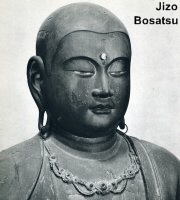
Borrowing time, the face of Jizo; repaying time, the face of Enma.

My book used pictures to describe this one and I’ll do the same.


Jizo

              
                  Enma

Monday, August 2, 2010

Buddhist Proverbs: Part I

A book I’m reading lists 100 Japanese proverbs to “illustrate certain effects of Buddhist teaching upon popular thought and speech.” Many of them are rather abstract and require gigantic footnotes to explain the translation for a foreign audience. But there were also a lot of them that I felt made sense without further explanation and I thought I’d share them with you. And there were a few that really need explaining, but I still really liked them, so I’ve done my best to explain. There ended up being quite a few, so I have divided them up into two posts for easier digesting. These are listed in no particular order.

Meeting is only the beginning of separation.
Hell and Heaven are in the hearts of men.
Heard of only, it is Paradise; seen, it is Hell
Good actions go not outside the gate; bad deeds travel a thousand ri.
The future life is the all-important thing.
Even a worm an inch long has a soul half an inch long.
The body is tortured only be the demons of the heart (or mind).
Even the Buddha was originally but a common man.
Even to become a Buddha one must first become a novice.
The blind man does not fear the snake.
There is no King on the Road of Death.
One confession effaces the sins of even three years.
Only by reason of having died does one enter into life.
All joy is the source of sorrow.
Joy and sorrow exist only in the mind.
Eggplants do not grow upon melon vines.


Even the head of an iwashi, by virtue of faith will have the power to save.

An iwashi is a small sardine like fish. It implies that what you worship matters rather little so long as your prayer is made with perfect faith and pure intentions. It’s all about the power of faith.


Having waxed, wanes.

Think of the moon. Once it has reached its fullest it begins to wane. So also the height of good fortune is also the beginning of fortune’s decline.


It is not easy to be born among men and to meet with the good fortune of hearing the doctrine of Buddhism.

Remember that we are dealing with reincarnation here. It takes many good lives to be blessed with being born as a member of mankind. And according to Buddhism, you are even more privileged if you are among those who are teaching Buddhism. This is because only as humans are we capable of spiritual progress. So no matter how miserable your situation, you should still be thankful that you are a person.


The Six Roads are right before your eyes.

Another to do with reincarnation. Our actions in our current life determine what we will be reincarnated as. So we are really in control of our own destiny and choose where we will be born next by acting appropriately in this life.


That will do it for part one! Please feel free to discuss in the comments, I’m really interested in what people think. Let me know if there is one you find particularly interesting, or if there is one that you don’t understand. I don’t know how familiar everyone is with Buddhism, and so some that I think make sense might make no sense to everyone else. If this happens I’ll do my best to try to explain. Check back later for part two which includes most of my favorites.

Saturday, May 22, 2010

Found in Translation

So I was teaching probably my favorite class at elementary school. It’s a very small school so my fifth and sixth grade classes are combined. This means we do half of the fifth grade textbook and half of the sixth grade textbook. It’s a little confusing, and with some of my other students it would never work, but these kids are amazing and it hardly seems to faze them. They are always super excited about English and it is just a joy to be in their class.

I have been incredibly lucky. Both years we have used the textbook at that school I have had amazing teachers who have really taken it upon themselves to teach English and not to just be in the class while I am teaching English. It is clear that they are studying English on their own so that they can be confident for the class. They don’t let English intimidate them like some of the other elementary teachers I have worked with. They work hard and show the kids that they can do it too. And that positive attitude from the teacher really makes a difference.

With elementary school we do virtually no reading or writing and focus instead on speaking and listening. The goal is to make the students comfortable studying English and to show them that English is fun so that when they get into junior high they don’t hate it. So we sing lots of songs and play lots of games. The current  lesson (each lesson goes about 4 classes) revolved around the topic of “I like”. In this class we were playing a game where the students asked me if I liked something and then they had to guess if I liked it or not. If they thought I liked it they went to the left side of the room and if they didn’t think I liked it they went to the right side of the room. In the book they suggest you have cards and use those as the sentence topics. But we have a small class of 12 so we decided to just skip the cards and be more creative.

We let the students powwow in the back and decide on something to ask me. Then they all lined up in a straight line in the middle of the room (so cute!) and asked me “Do you like whatever-the-thing-was?” I would then make a thinking face while they all ran to the side of their guess. Then they asked me again and I answered, “Yes, I do” or “No, I don’t” as appropriate. The kids who were correct celebrated and then we started again.

We told the kids that Japanese was okay, but if they knew the English word they used it. Then they asked, "Do you like hiyoko?"  I didn’t know what that was. I looked to the teacher and he tried to think about it and then the kids did something awesome. They started to explain what it was to me with other English words they knew. “Yellow bird!” one girl said making little wing motions. “Small bird. Baby bird!” another said. I was stuck thinking it might be a canary, so I asked if it was a pet. They said no and then they started to draw pictures on the board. Finally it all clicked in my brain that they were talking about chicks and I asked, “Baby chicken?” They were so excited that I understood. And so the game continued.

I was blown away by their positive attitudes. I have many junior high students who would not even think to do those things to try to be understood. And if they did they certainly wouldn’t have used English words to do so. For many of my students once communication hits a roadblock they shut down. They stop and look at the teacher if he is around hoping he will fill in the blanks for them. It’s a perfectly understandable thing; I’ve done the same in Japanese at times. Communicating can be really hard. But these fifth and sixth graders didn’t even hesitate. The whole class was on a mission to bridge the gap in understanding.

After class I realized that if I had perfectly understood their Japanese these kids would have missed out on a wonderful opportunity. Without meaning to, the lesson became not only about a simple grammar point, but about communication and understanding. Theoretically all lessons are about that, but normally it’s me using English (my native language) to try to get them to understand something and they are the ones trying to decipher meaning. This flipped the tables around and they were the ones with the information trying to pass it on. I really feel this was the most valuable part of that lesson. I hope that they can keep that energy and passion as they continue to study English. And I hope that they all had the same warm fuzzy feeling that I did when I finally understood what they were telling me.

Wednesday, May 12, 2010

Amanda is Amanda!

Okay, I’m a linguist at heart, so you’ll have to bear with me as this post will be mostly my random observation and my lack of explanation for something entirely language related. Could this be learning in disguise?!? It’s like Transformers, but with fewer explosions.

So, I had seen in manga and anime where characters, normally young girls, refer to themselves in the third person. One of the most recent examples was in a one-shot in Shonen Jump where a young girl who had been raised by cat people introduced herself to a boy, saying, “Tama wa Tama da yo!” Which basically translates to “Tama is Tama!” (Tama is a common name for cats in Japan, like Fluffy in America or Rover or Spike are for dogs) It’s cute, and amusing to read, but I have now observed this is real life.